
Have you ever wondered why your home-brewed coffee tastes different every time, even when you’re using the same beans? The answer often lies in the coffee ratio—the relationship between the amount of coffee grounds and the amount of water you use. Understanding and mastering coffee ratios is the single most effective way to take control of your brew and consistently produce a cup that matches your desired strength and flavor profile.
This guide will demystify coffee ratios, explain why they matter, and provide a clear framework for finding your perfect recipe.
Why Ratios Are the Key to Consistency
While there are many variables in coffee brewing (grind size, water temperature, brew time), the ratio of coffee to water is the most fundamental. It acts as the blueprint for your brew’s concentration. Relying on imprecise measurements like “a scoop” or “eyeballing it” is the number one cause of inconsistent coffee.
- Under-dosing coffee (using too little coffee for your water) results in a weak, watery, and often sour cup because the water hasn’t had enough grounds to extract from.
- Over-dosing coffee (using too much coffee for your water) results in a strong, bitter, and harsh cup because the water has been over-saturated with extracted compounds.
By using a scale and a specific ratio, you eliminate the guesswork and ensure that every brew starts from a consistent foundation.
The Golden Ratio and Beyond
The coffee industry often refers to a “Golden Ratio” as a starting point. This is typically a 1:15 or 1:16 ratio, which means for every 1 part of coffee, you use 15 or 16 parts of water.
- 1:15 Ratio: A slightly stronger brew.
- 1:16 Ratio: A well-balanced, classic strength. This is an excellent place to start for most brewing methods.
Example Calculation (Using a 1:16 Ratio)
Let’s say you want to brew a 12-ounce cup of coffee. Since 1 ounce is approximately 30 grams of water, a 12-ounce cup is about 360 grams of water.
- Water Weight: 360 grams
- Divide by Ratio: 360 / 16 = 22.5 grams
- Coffee Weight: 22.5 grams
So, to make a 12-ounce cup of coffee at a 1:16 ratio, you would use 22.5 grams of coffee and 360 grams of water. This simple calculation allows you to scale your recipe up or down for any size.
Common Ratios Explained (by Brew Method)
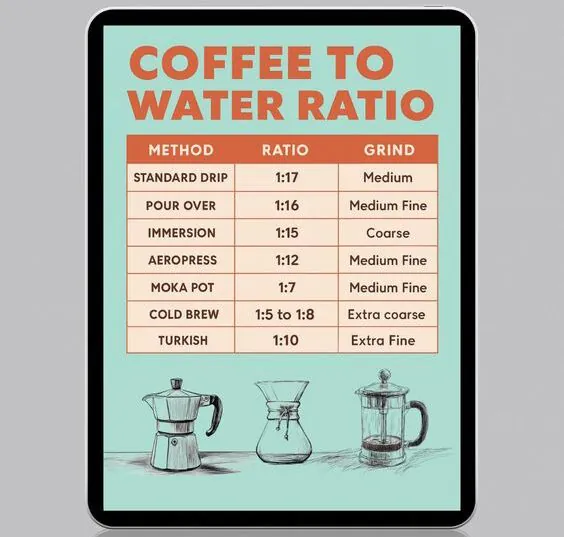
Different brewing methods often have their own ideal ratios due to their unique extraction times and contact with water. Here’s a breakdown:
- Pour-Over (Chemex, V60): 1:15 to 1:17
- Reasoning: The relatively short contact time requires a precise ratio to achieve a balanced extraction. The golden ratio of 1:16 is a perfect starting point. A 1:15 will give you a slightly richer cup, while a 1:17 will be a little lighter.
- Drip Coffee Machine: 1:15 to 1:17
- Reasoning: Similar to pour-over, this method benefits from the balanced golden ratio. However, you might need to adjust based on the specific machine’s brew temperature and time.
- French Press: 1:12 to 1:15
- Reasoning: The longer immersion time of a French Press means the coffee is in contact with the water for a longer period. A slightly lower ratio (more coffee relative to water) is often used to prevent over-extraction and bitterness. A 1:12 or 1:13 ratio is a great place to start.
- Cold Brew: 1:4 to 1:8 (for a concentrate)
- Reasoning: Cold brew is all about making a strong concentrate that will be diluted later. The ratio is much lower here to account for the slow, low-temperature extraction. A 1:8 ratio is a good middle ground for a versatile concentrate. You’ll then dilute it with water or milk, often at a 1:1 ratio.
How to Find Your Perfect Ratio
- Start with the Golden Ratio: Begin with a 1:16 ratio for your pour-over or drip machine.
- Brew and Taste: Make a cup and taste it carefully. Is it too strong? Too weak? Note down your thoughts.
- Adjust by 1 or 2 Points:
- Too Strong/Bitter? Increase the water. Move to a 1:17 or 1:18 ratio.
- Too Weak/Sour? Decrease the water. Move to a 1:15 or 1:14 ratio.
- Keep it Consistent: Once you find a ratio you love, stick to it. Use your scale every time to weigh your coffee and water.
Common Mistakes to Avoid
- Using Volume Instead of Weight: A “tablespoon” of coffee can vary widely depending on the grind size and how packed it is. Always use a digital scale for accuracy.
- Ignoring the Grind: The ratio and the grind size work together. If your coffee is too bitter, it could be the grind (too fine) or the ratio (too high). Adjust one variable at a time to isolate the problem.
- Forgetting the Water: Water quality and temperature are also key variables. Even with a perfect ratio, bad water will produce bad coffee.
Understanding coffee ratios is the first and most crucial step on the journey to brewing excellent coffee. It’s the simple secret that separates inconsistent, hit-or-miss coffee from a reliably delicious, perfectly balanced cup. So grab your scale, find your ideal ratio, and brew with confidence!
Recommended YouTube Video:
For a visual demonstration of how to use a scale and understand ratios, watch this video:
Coffee Brewing Ratios Explained – https://www.youtube.com/watch?v=ipB6P1uzNYM