
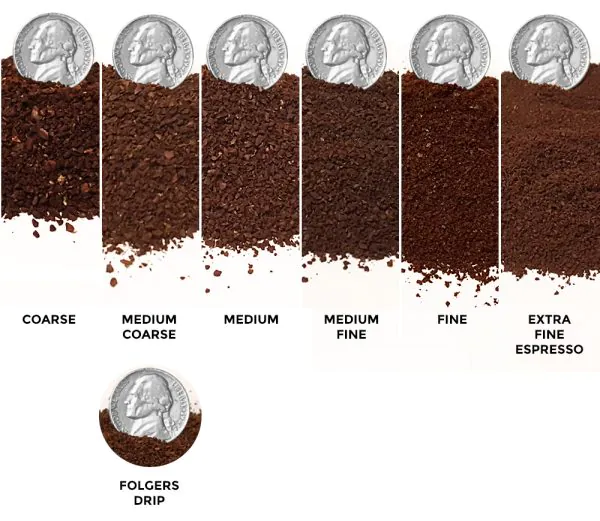
Ever wondered why your Coffee tastes muddy or your Espresso is too watery? The secret often lies not in the beans, or even the water, but in one crucial step: the grind size. It’s the foundation of great coffee, dictating how quickly water extracts flavor from your beans.
Too coarse, and your coffee will be under-extracted and weak. Too fine, and it’ll be over-extracted, bitter, and astringent. Getting it just right is the key to unlocking your coffee’s full potential, ensuring a balanced and delicious cup every time.
Let’s dive into the ideal grind sizes for all your favorite brewing methods.
Understanding Grind Consistency: Why It Matters
Before we get to specific sizes, a quick word on consistency. A good grinder (preferably a burr grinder over a blade grinder) is crucial for an even grind. If your grind has a mix of coarse and fine particles, you’ll end up with both under and over-extraction simultaneously, leading to a muddled flavor. Invest in a quality grinder, and your coffee will thank you!
Your Grind Size Cheat Sheet for Every Brew
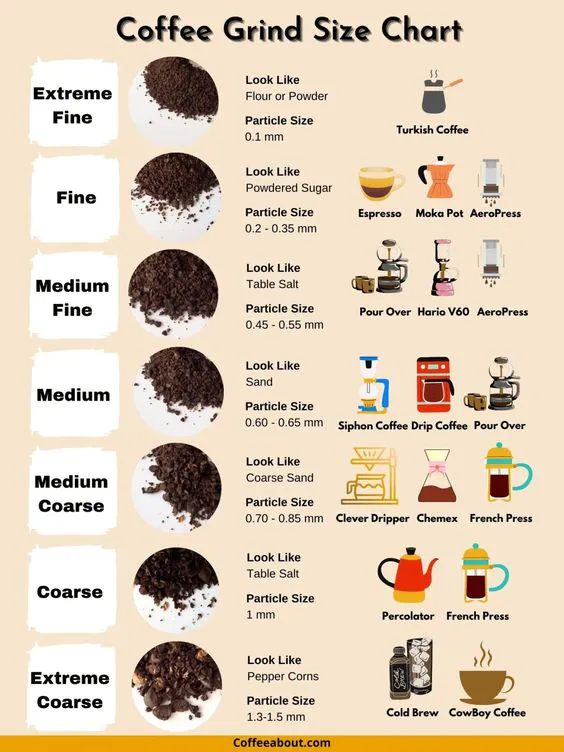
Here’s a breakdown of the most common brewing methods and their ideal grind sizes, complete with descriptions to help you visualize them.
1. Extra Coarse Grind
- Texture: Large, chunky particles, like cracked peppercorns or very coarse sea salt.
- Best For: Cold Brew
- Why: Cold brew steeps for a very long time (12-24 hours). An extra-coarse grind prevents over-extraction and bitterness, allowing for a smooth, low-acid concentrate.
2. Coarse Grind
- Texture: Resembles chunky sea salt or breadcrumbs. You can clearly see individual particles.
- Best For: French Press, Coffee Percolators
- Why: These methods involve long immersion times. A coarse grind ensures slower extraction, preventing over-extraction and the silty, muddy texture often associated with a too-fine grind in a French Press.
- Visual Aid: For a fantastic visual guide on grind sizes, especially for French Press, check out this video from James Hoffmann’s Ultimate French Press Technique:
- [YouTube Video Reference: Search for “James Hoffmann French Press” – his video clearly shows grind size comparison.] (You can link directly here if embedding is an option on your blog platform)
3. Medium-Coarse Grind
- Texture: Similar to rough sand.
- Best For: Chemex, Clever Dripper
- Why: These pour-over methods have a slightly longer contact time than a V60. The medium-coarse grind allows for optimal flow rate and balanced extraction for their unique filters.
4. Medium Grind
- Texture: The consistency of regular sand.
- Best For: Drip Coffee Machines, Hario V60, Aeropress (longer brew times)
- Why: This is often considered the “standard” grind. It’s versatile and works well for methods where water passes through the grounds at a moderate pace, allowing for balanced extraction. For pour-overs like the V60, it provides a good balance between flavor extraction and flow rate.
5. Medium-Fine Grind
- Texture: Finer than sand, but still gritty. A bit finer than table salt.
- Best For: AeroPress (shorter brew times), Siphon Brewers, Moka Pot (some prefer slightly finer)
- Why: This grind works for methods with slightly faster brew times or where more resistance is needed for proper extraction. For AeroPress, it can help achieve a stronger cup in a shorter time.
6. Fine Grind
- Texture: Smooth, like table salt or powdered sugar, but still with a slight grittiness.
- Best For: Espresso Machine, Moka Pot, Aeropress (inverted method, very fast brew)
- Why: Espresso machines use high pressure and very short brew times (20-30 seconds). A fine grind creates the necessary resistance for proper extraction, producing that iconic crema and intense flavor. For Moka Pots, a fine grind helps build pressure and extracts a strong, concentrated coffee.
- Visual Aid: Seeing an espresso grind up close is key. This video demonstrates the ideal texture for espresso:
- [YouTube Video Reference: Search for “Lance Hedrick Espresso Grind Size” or “Chris Baca Espresso Grind” for expert visual examples.] (Again, link directly if embedding is possible)
7. Extra Fine / Turkish Grind
- Texture: Powdery, like flour or confectioners’ sugar.
- Best For: Turkish Coffee
- Why: Turkish coffee is unique because the grounds are fully immersed and consumed with the coffee. The extra-fine grind allows for maximum extraction and creates the characteristic thick body.
Why Your Grind Might Need Adjustment (Even If It’s “Right”)
Even with this guide, you might need to fine-tune. Here’s why:
- Bean Type & Roast: Lighter roasts are denser and often require a finer grind than darker roasts to achieve full extraction.
- Age of Beans: Fresher beans can extract differently than older beans.
- Brew Time: If your brew is too fast, try finer. If it’s too slow, try coarser.
- Taste: Ultimately, your palate is the best judge. Adjust until it tastes delicious!
The Bottom Line: Experiment!
Don’t be afraid to experiment! Start with our recommendations, brew a cup, and then adjust slightly coarser or finer based on your taste. A little trial and error will lead you to your perfect cup. Happy grinding!
Recommended YouTube Video:
For a visual demonstration of how to use a scale and understand ratios, watch this video:
https://www.youtube.com/watch?v=5BCDIas33y0